Awards season · Post-Production & VFX
Heart of the Beast Runs 700-800 VFX Shots to Fake Alaska in New Zealand
François Dumoulin's 700-800-shot VFX effort on Heart of the Beast: CG fangs, kabuki-styled wolves, a truss-crashed Cessna, photogrammetry-built tree bridge and zero CG water.
Production notes
- Heart of the Beast contains 700-800 VFX shots across seven vendors including Framestore, Rodeo FX and Crafty Apes.
- New Zealand doubled for Alaska; the country's lack of predators forced fully digital moose, wolves, birds and a grizzly bear.
- A hollowed-out Cessna crashed on a truss into a water tank; the high-speed phase is digital.
- The team rejected CG water, citing cost, schedule and director preference.
- Wētā Workshop built practical prosthetic legs for four dogs, with post add-ons on slippery terrain.
Paramount's survival thriller Heart of the Beast carries 700 to 800 visual effects shots, with VFX Supervisor François Dumoulin coordinating work across Framestore, Rodeo FX, Crafty Apes, Rebel, Opsis, BOT VFX and Soho VFX. Director David Ayer's film stars Brad Pitt as Special Forces veteran James Belmont, who crashes a Cessna bush plane in the Alaskan wilderness and survives alongside Odin, a three-legged former combat German Shepherd.
How do you shoot a three-legged hero dog?
Practical prosthetics came first. "The prosthetic leg was practical and built specifically for our four dogs by Wētā Workshop," said Dumoulin, whose credits include Lovecraft Country and The Sandman. "It looked fantastic, but in some scenarios, we could not use it because the terrain was too slippery or it would prevent the dog from running fast enough." A good number of shots got the prosthetic added in post. Odin's titanium upper fangs went fully CG — the dog rarely shows teeth, keeping the volume manageable.
Four dogs played the role. Hero dog Uber served as the CG model base, with makeup, scars and fur discoloration applied on set. Three of Uber's sons covered backup duty, chosen for physical resemblance and temperament. Some scenarios needed facial performance; others needed action. Different dogs trained for different purposes.
What happened with the wolfpack fight?
The wolf attack pivots the film into nightmare territory. "Wolves keep coming from everywhere," Dumoulin said. A real dog gave action reference, while a stunt performer on all fours doubled as a wolf — "You're not going to launch a real wolf at Brad Pitt." Fake wolf heads mounted on gloves handled biting choreography. Dumoulin's on-set job included eyeline policing: wolf eyes sit above the jaw, so Pitt couldn't track the stunt performer's face.
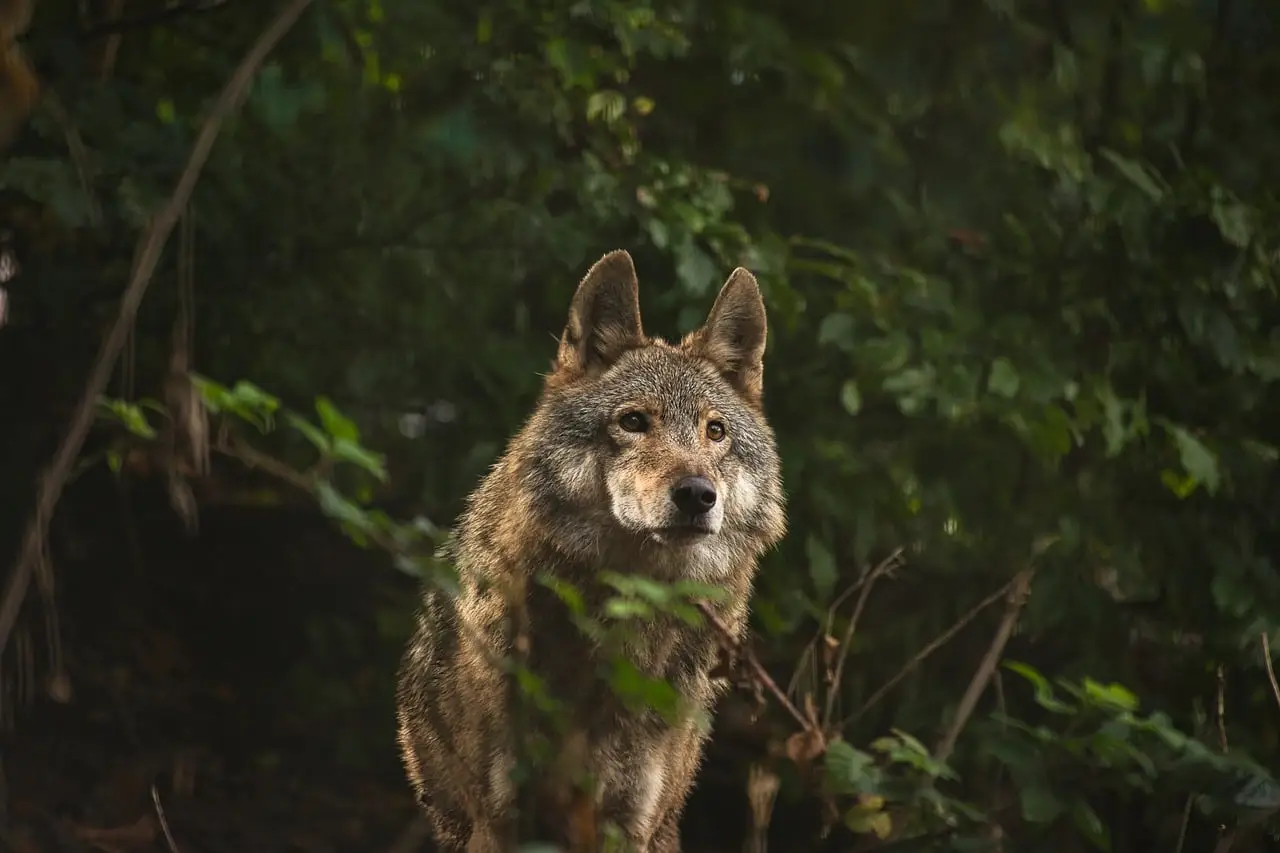
Ayer rejected a generic wolf design. The pack reads dehydrated, starving and scarred, with dark-and-bright facial markings inspired by Japanese kabuki theatre, where expression lives in the painted face. Some wolves carry teeth in their fur, reading like skulls. "This movie is not a documentary; it's a spiritual journey," Dumoulin said.
New Zealand doubled for Alaska. With no native predators in the country, the digital roster covers a moose family, the wolfpack, a flock of birds and a scarred, aging grizzly bear that mirrors the protagonist. Set extensions added snowy mountains.
War flashbacks, shot on an Oakland backlot against bluescreen, got defocused, overexposed multiple-exposure treatments plus extended streets, added buildings and augmented explosions.
How did they crash the plane?
Dumoulin shot two days of aerial photography with a six-camera array, capturing a 200-degree field of view in one pass for bluescreen replacement. The cockpit interior couldn't take the dog, so a matching cockpit sat on a motion base on an Oakland soundstage, with crane-mounted light rigs rotating instead of the gimbal to replicate sun movement. For the crash, a hollowed Cessna on a giant truss dropped into a water tank surrounded by bluescreen. The shell couldn't hit full speed, so the fast phase is digital, with a takeover to the physical truss crash.
The team ruled out CG water entirely. "CG water is complex, hard to nail, time-consuming, and often quite expensive," Dumoulin said, citing a compressed post schedule. The tree-bridge crossing went hybrid: the real river location was too dangerous, so VFX and art teams scanned it via photogrammetry and drone capture, the production designer plugged his tree-bridge design into the 3D model, 3D-printed the rocks, and rebuilt the cliff section on the backlot — oriented so the sun matched the reference site one to one.
A rapids sequence mixed a waterpark tank outside Oakland with bluescreen, machine-learning face swaps between the stunt double and Pitt, and a real New Zealand river with a double.
Collaboration anchored everything. Dumoulin gave every department an on-set representation of the final shot, from placeholder puppets for animal blocking to a Gaussian splat (a 3D scene reconstruction from photos) on his phone for set-extension previs. Producer Pitt pushed hard on story arc, tone and character; producer Damien Chazelle (Whiplash, Babylon) weighed in as well, and the editorial room cut competing versions. The first question everyone asked, Dumoulin said: "Does the dog live?"
via bmd.link (Original)
More from Sophie Lindqvist
Show full bio
Market editor covering regulation, policy and their impact on Filmmaking News is the working trade daily for at Filmmaking News.
191 articles
Further readings
- Aardman Built 11 Beast Puppets and Half a Ship for 'Beast of Mossy Bottom'November 24, 2026
- Graham Page Reveals the ‘Sheep-isms’ Behind The Sheep DetectivesNovember 26, 2026
- The Man Who Ran Up Rocky's Steps: Garrett Brown's Steadicam StoryNovember 20, 2026
- Finland's Oscar Entry 'The Squirrel' Lands North American DealNovember 26, 2026
- VFX Studios Break Down the Backrooms: 600 Shots, Three ReelsNovember 22, 2026